Dental Implants
Permanent, natural-looking tooth replacement that restores bite and confidence.
Complete dental care for every age and every smile.
Permanent, natural-looking tooth replacement that restores bite and confidence.
Braces and aligners to straighten teeth and correct bite alignment.
Pain-free endodontic care that saves infected and damaged teeth.
Safe, professional whitening for a brighter, healthier-looking smile.
Gentle, friendly dental care designed especially for children.
Careful removal of impacted or damaged teeth with minimal discomfort.
Spotlight
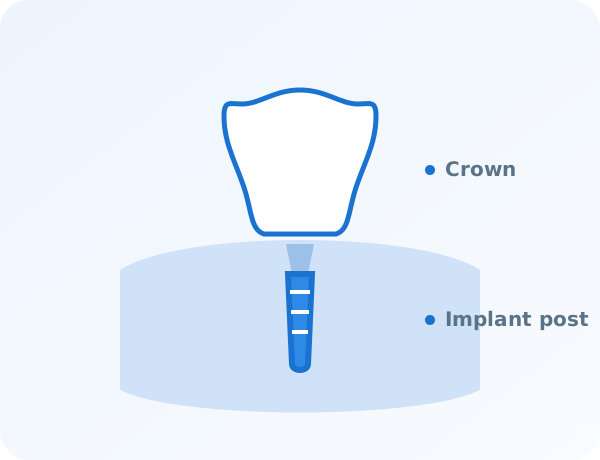
A dental implant is a permanent replacement for a missing tooth. A small titanium post is placed in the jaw to act as a sturdy root, then topped with a natural-looking crown that blends with your smile.
In detail
Learn more about each treatment we offer. Tap a topic to jump straight to it.
Straightening teeth and correcting bite for a healthier, more confident smile.
Crooked and crowded teeth are hard to clean and maintain. This may contribute to conditions that cause not only tooth decay but also eventual gum disease and tooth loss. Other orthodontic problems can contribute to abnormal wear of tooth surfaces, inefficient chewing, excessive stress on the gum tissue and supporting bone, or misalignment of the jaw joints, which can result in chronic headaches or pain in the face or neck. The value of an attractive smile should not be underestimated — a pleasing appearance is a vital asset to one's self-confidence. A person's self-esteem often improves as treatment brings teeth, lips and face into proportion, benefitting social and career success as well as one's general attitude towards life.
Children and adults can both benefit from orthodontics, because healthy teeth can be moved at almost any age. Because monitoring growth and development is crucial to managing some problems well, we recommend that all children have an orthodontic screening no later than age 7. Some problems are easier to correct if treated early; waiting until all permanent teeth have come in, or until facial growth is nearly complete, may make correction more difficult.
Custom-made appliances, or braces, are prescribed and designed by the orthodontist according to the problem being treated. They may be removable or fixed (cemented and/or bonded to the teeth) and made of metal, ceramic or plastic. By placing a constant, gentle force in a carefully controlled direction, braces slowly move teeth through their supporting bone to a new desirable position. Orthopedic appliances such as headgear, bionator, Herbst and maxillary expansion appliances use carefully directed forces to guide the growth and development of the jaws in children and teenagers.
Today's braces are generally less noticeable than those of the past. Brackets are now bonded directly to the tooth, minimizing the old "tin grin", and can be metal, clear or coloured depending on the patient's preference. In some cases brackets may be bonded behind the teeth (lingual braces). Recent advances mean braces are smaller and more efficient, and the wires are no longer just stainless steel — they are made of alloys of nickel, titanium, copper and cobalt, with some wires being heat-activated.
Surgical care for the function and esthetics of the head, face, mouth, teeth, gums, jaws and neck.
This branch involves the surgical and related treatment of diseases, injuries and deformities affecting both the functional and esthetic aspects of the head, face, mouth, teeth, gums, jaws and neck. The procedures we perform include:
Preserving natural tooth structure — a mercury-free clinic.
This branch deals with conservation of tooth structure lost as a result of caries, trauma or fracture. The tooth is filled with tooth-coloured (composite) material. We do not use amalgam fillings, which contain mercury — ours is a mercury-free clinic.
Saving infected teeth through root canal treatment.
Root canal treatment (endodontics) is needed when the blood or nerve supply of the tooth is infected through decay or injury. In some cases the tooth darkens in colour, which may mean the nerve is dead or dying and requires root canal treatment. The aim is to remove all infection from the root canal; the root is then cleaned and filled to prevent further infection. A local anaesthetic is used, so it feels no different to having an ordinary filling. Afterwards a crown is placed over the tooth to protect it.
Diagnosis and management of gum disease.
Periodontics involves the diagnosis and management of diseases of the gingiva and periodontium. We are committed to motivating and educating the community about oral hygiene maintenance, as poor hygiene is one of the leading causes of early loss of teeth.
Replacing missing teeth with dentures, crowns, bridges and implants.
Prosthodontics means the replacement of missing teeth and associated structures by removable partial dentures, fixed partial dentures and complete dentures. Complete dentures are made when all the teeth have been lost. Partial dentures replace anything from a single tooth to many teeth, either removable or fixed. Fixed partial dentures are made with crowns and bridges.
A dental implant is an artificial tooth root placed into the jaw to hold a replacement tooth or bridge. Implants are an ideal option for people in good general oral health who have lost a tooth or teeth due to periodontal disease, injury or other reasons. While high-tech in nature, implants are actually more tooth-saving than traditional bridgework, since they do not rely on neighbouring teeth for support.
Comfortable, modern treatment to save a damaged tooth.
Every tooth consists of three layers. The outermost and hardest layer is enamel, the second layer is dentin, and the third is the pulp — the cavernous space where the live tissue and nerve of each tooth is located.
If the pulp space is exposed to the outside, the tissue becomes contaminated and eventually infected. This exposure happens in many circumstances, such as a large cavity or a fractured tooth, and your dentist can explain the exact reason for the damage. Root canal treatment is the process of going inside the pulp space and removing the infected, dead tissue. The space is then disinfected and sealed with special materials.
Nowadays, root canal treatments are performed with advanced techniques and materials, making them far more comfortable and faster. Once complete, your restorative dentist will usually place a crown on the tooth to safeguard against fracture. If you have any questions about root canal treatment, give us a call today.
Restoring strength and appearance to damaged or missing teeth.
A crown (cap) is a restoration placed on teeth that have lost a lot of their structure. There are various types, ranging from full porcelain to full metal crowns; your dentist will explain the advantages and disadvantages of each.
Crowns may also be used to securely attach a bridge when the surrounding teeth are inadequate on their own. A bridge is a dental appliance used to replace one or more missing teeth, designed to be cosmetically appealing and to restore proper occlusion. Like crowns, bridges are fully customizable and made of various materials, including porcelain and metals.
Both crowns and bridges are created to match the colour, height, texture and overall appearance of your teeth. Most will last for life and only need replacing if they fall out or become loose. You can prolong their durability by practising good oral hygiene and visiting your dentist for regular check-ups and cleanings.
Affordable, versatile options to replace lost teeth.
Despite many advances in dentistry, loss of teeth is still an ongoing problem — around 26% of adults between the ages of 65 and 75 have lost all of their teeth. Several options are available, and one of the most versatile and affordable is a set of removable dentures.
Partial dentures replace only a limited number of teeth, not an entire set. A partial denture is a single-piece fitting supported by the remaining teeth and gums. They are much more secure and comfortable than standard full dentures.
Standard full dentures comprise a full set of upper and lower teeth and use suction to stay in place. They are made of a pliable material that makes suction easy — which is also why they require routine visits to the dentist.
Cosmetic dentures are made to look as natural as possible. Unlike standard dentures made with a heat-curing process that become ill-fitting over time, cosmetic dentures use a special acrylic base that eliminates shrinking and warping. Some cosmetic dentures achieve a natural appearance using implants: the denture rests on or snaps onto the implant, holding it firmly in place so it stays comfortable and does not move around.
A simple, effective routine for healthy teeth and gums.
The first step is to choose a good toothbrush — always use a soft brush with a small head. A soft brush is firm enough to remove plaque, yet gentle enough not to damage your teeth or gums.
Next, select a good toothpaste. In general any toothpaste that contains fluoride will do the job, unless you have special needs determined by your dentist.
Start from a specific spot and work your way around to the opposite side, continuing through the whole mouth so that you finish where you started — this way you won't miss any area. A pea-sized amount of toothpaste is enough, and an adequate brushing should take at least 2 minutes, preferably around 4.
Hold the brush at a 45-degree angle toward the teeth and gums and gently press so the tips of the bristles go between the gum and the teeth. Apply a few lateral strokes, then roll the brush to sweep plaque away from the teeth and gums. Repeat 6 to 10 times, then move on to the next 2–3 teeth. On chewing surfaces, short strokes work best to clean the grooves and pits; when brushing the back of your front teeth, hold the brush vertically to reach the teeth better.
Ideally, brush after each meal. If you can't, brush at least twice a day — after breakfast and before going to bed.
Our dentists are happy to explain your options and recommend the right care for you. Reach out and we will help.
Talk to our team